

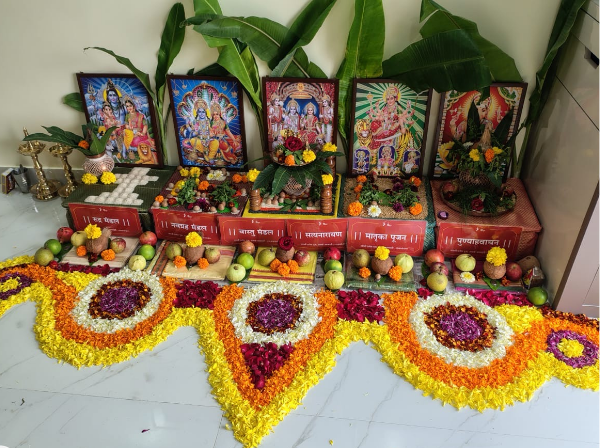
Moving into a new home is more than a physical transition, it’s a sacred milestone filled with emotion, energy, and new beginnings.
Naturally, families want to begin this journey with divine blessings, and that’s when two of the most important Hindu rituals come into discussion: Vastu Shanti Puja and Satyanarayan Puja.
A question that Vandan Pandit is often asked by homeowners across Maharashtra is: “Can we perform Satyanarayan Puja on the same day as Vastu Shanti?”
While this combination might sound ideal and time-saving, the answer according to the Vedic Shastra is – No.
Understanding the meaning of the Two Ceremonies
Both rituals Vastu Shanti and Satyanarayan Puja are immensely important, but their intentions, energies, and deities differ. Understanding this distinction is key to performing them in alignment with Shastriya (scriptural) principles.
Vastu Shanti Puja: The Ceremony of Cleansing and Harmony
The Vastu Shanti Puja is performed to pacify the Vastu Purusha, the divine spirit of the dwelling, and to bring balance among the five elements earth, water, fire, air, and space.
It falls under Shanti Karma, meaning a ritual dedicated to purification, peace, and balance.
This puja is particularly important for newly constructed or newly purchased homes, as it:
- Eliminates negative energies that may linger from previous ownership, construction, or the land itself.
- Corrects Vastu Doshas and harmonizes the flow of energy across all directions.
Essentially, it prepares the home to become a true “gruh” a spiritually balanced space that supports prosperity and happiness.
Satyanarayan Puja: The Ceremony of Gratitude and Prosperity
The Satyanarayan Puja, dedicated to Lord Vishnu in the form of Satyanarayan, is a Pushti Karma, a ritual of fulfillment, devotion, and abundance.
It is often performed to express gratitude for milestones such as a new home, marriage, or success.
Through devotional chanting, katha (story narration), and offerings, this puja symbolizes truth, faith, and divine prosperity. It blesses the home with ongoing happiness and ensures that success is guided by spiritual grounding.
Should You Perform Both Pujas on the Same Day?
While both Vastu Shanti and Satyanarayan Puja are sacred, their spiritual objectives contrast one another.
- Vastu Shanti is about cleansing what existed before ; removing blocks and negativity.
- Satyanarayan Puja is about celebrating what has begun ; invoking joy and divine blessings.
When both are performed on the same day, the two energies Shanti (peaceful detachment) and Pushti (celebratory expansion) clash.
Each demands its own atmosphere: Vastu Shanti requires calm focus and cleansing energy, while Satyanarayan Puja invites festive devotion and joy.
Just as meditation and celebration cannot happen at the same moment, these two ceremonies cannot be fully realized together.
Why Both Shouldn’t Be Done Together
In the Vedic system of rituals, each puja follows a clear principle — one ritual, one intention, one presiding deity.
On the day of Vastu Shanti, the Vastu Purusha becomes the central deity.
During Satyanarayan Puja, Lord Vishnu is the presiding deity.
Performing both together divides the sanctity of focus. The scriptures clearly state that only one primary deity should be worshipped in a single karma.
When two divine energies are simultaneously invoked with opposing intentions, one pacifying and one celebratory, the spiritual essence of both gets diluted.
To use a simple analogy:
Just as there can be only one leader directing a nation at a time, there can be only one presiding deity directing a ritual’s energy.
Moreover, Vastu Shanti Puja is considered Ashubha Karma (pacifying ritual for peace after cleansing), while Satyanarayan Puja is a Shubha Karma (prosperous ritual for blessings).
Since Shubha and Ashubha karmas are opposite in nature, combining them goes against Shastriya logic and balance.
The Correct Way to Perform Both
If you wish to perform both Vastu Shanti and Satyanarayan Puja, the proper way as guided by experienced pandits and Vedic texts is sequential.
- Perform the Vastu Shanti Puja first, on your Griha Pravesh day.
- This purifies the house, balances the energies, and removes all doshas.
- It sets the spiritual foundation for your home and family.
- This purifies the house, balances the energies, and removes all doshas.
- Within the next one or two months, perform the Satyanarayan Puja.
- By then, your home is settled with positive vibrations.
- This puja then becomes an act of gratitude, thanking the divine for peace, prosperity, and abundance.
- By then, your home is settled with positive vibrations.
Following this sequence ensures both karmas — Shanti and Pushti — are fulfilled perfectly, giving you the maximum benefit of each ritual.
Combining rituals might seem efficient, but the Vedic system emphasizes intention and energy alignment over convenience.
Let each puja Vastu Shanti and Satyanarayan have its own sacred space, its own day, and its own divine focus.
This not only honors tradition but also ensures that your new home becomes a true abode of peace, happiness, and abundance.
If you’re searching for “Satyanarayan Puja Pune,” “Satyanarayan Puja near me,” “trusted pandit for Satyanarayan Puja,” or “traditional house puja services Pune,” Vandan Pandit is your most reliable partner.
Our certified panditji team offers authentic Satyanarayan Puja, house-warming Griha Pravesh Puja, and full Vastu-Shanti Puja across Maharashtra, all performed with correct muhurat, complete samagri, and scriptural precision.
1500+ trained and verified panditjis across Maharashtra
– Authentic Vedic rituals performed in Shatsrokt (scripture-based) manner
– Complete Puja materials arranged by the team
– Guidance for expectant mothers on peaceful prenatal practices
– Professionalism with cultural integrity
Book your Satyanarayan Puja today with Vandan Pandit
📞 Call: 8104030300 | 🌐 Available across Maharashtra
Trusted Panditji Services for a Pure an– d Meaningful Start to Life.